What's New

  1. Client Appointment Rebooking
    Improvement
    Reschedule Appointments

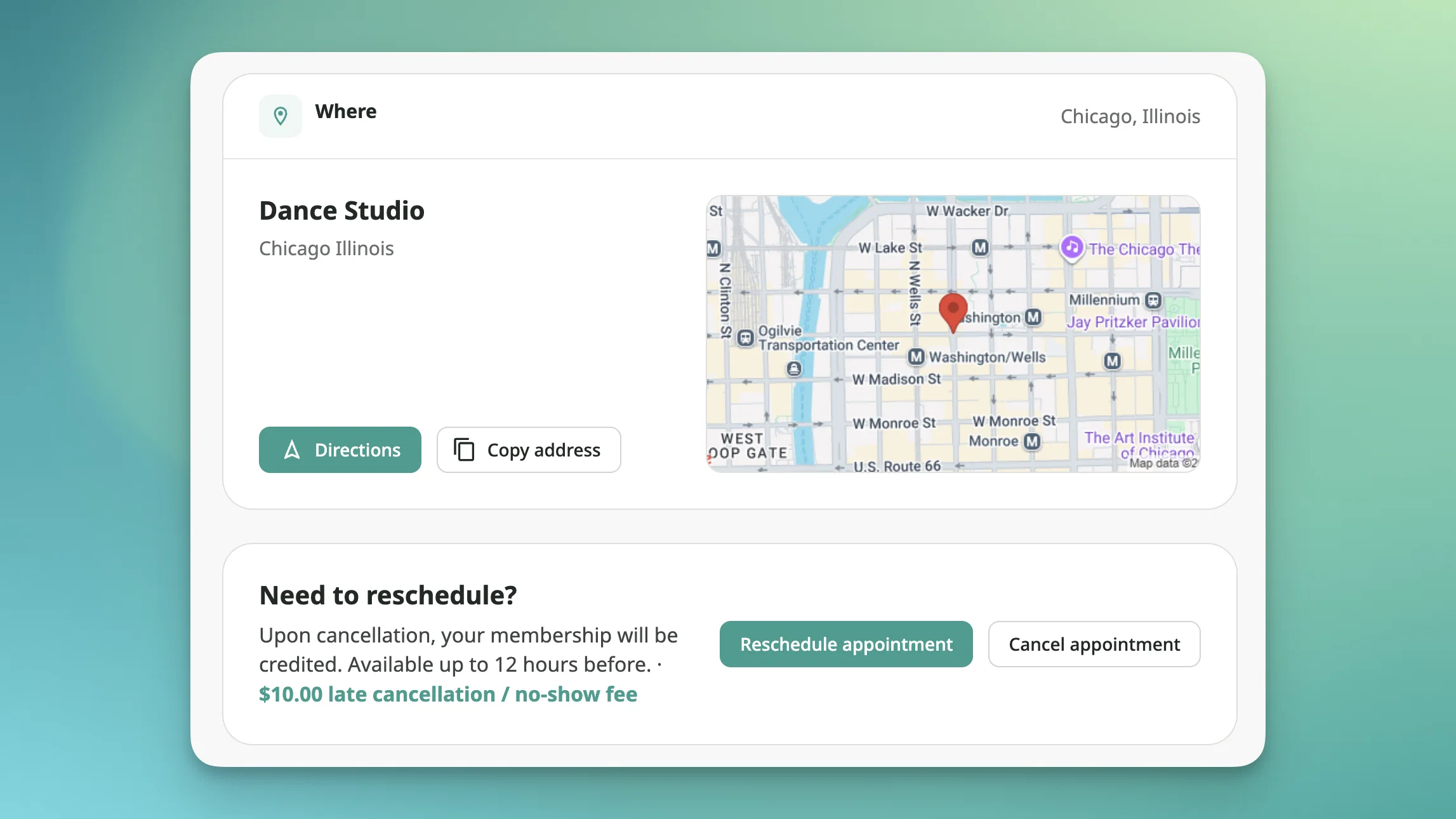
    Until now, clients who needed to move an appointment had to either cancel and start over or email the business and wait for a staff member to handle it manually. A simple reschedule became a support task every time.

    Clients can now rebook their own appointments in one step from the client web dashboard or the OfferingTree mobile app. 📅 They pick a new time for the same offering, and the original booking moves with them, payment and all.

    A few details worth knowing:

    Eligibility follows your refund policy. If an appointment is non-refundable or outside the refund window, clients will only see the option to cancel. No new configuration needed.

    Payment carries over. The original charge transfers to the new appointment automatically. There's no refund and re-charge cycle.

    Same offering only. Clients can pick a different time, but not a different offering. Switching offerings still requires cancelling and booking again.

    Staff and room assignments can change. For businesses using staff or room scheduling, clients can adjust those during rebooking, which opens up more available times.

    All standard booking rules still apply. Availability, capacity, and booking windows are enforced the same as any new booking.

    Both parties get updated. The client receives a new confirmation email and the business receives an updated appointment notification.

    Admins keep full control. Staff retain full rebooking ability regardless of refund policy.

    Available on all plans.
    2

    Comments

  2. Business App: Push Notifications, Text Messaging Inbox, and Roster Controls

    Improvement
    Business%20App

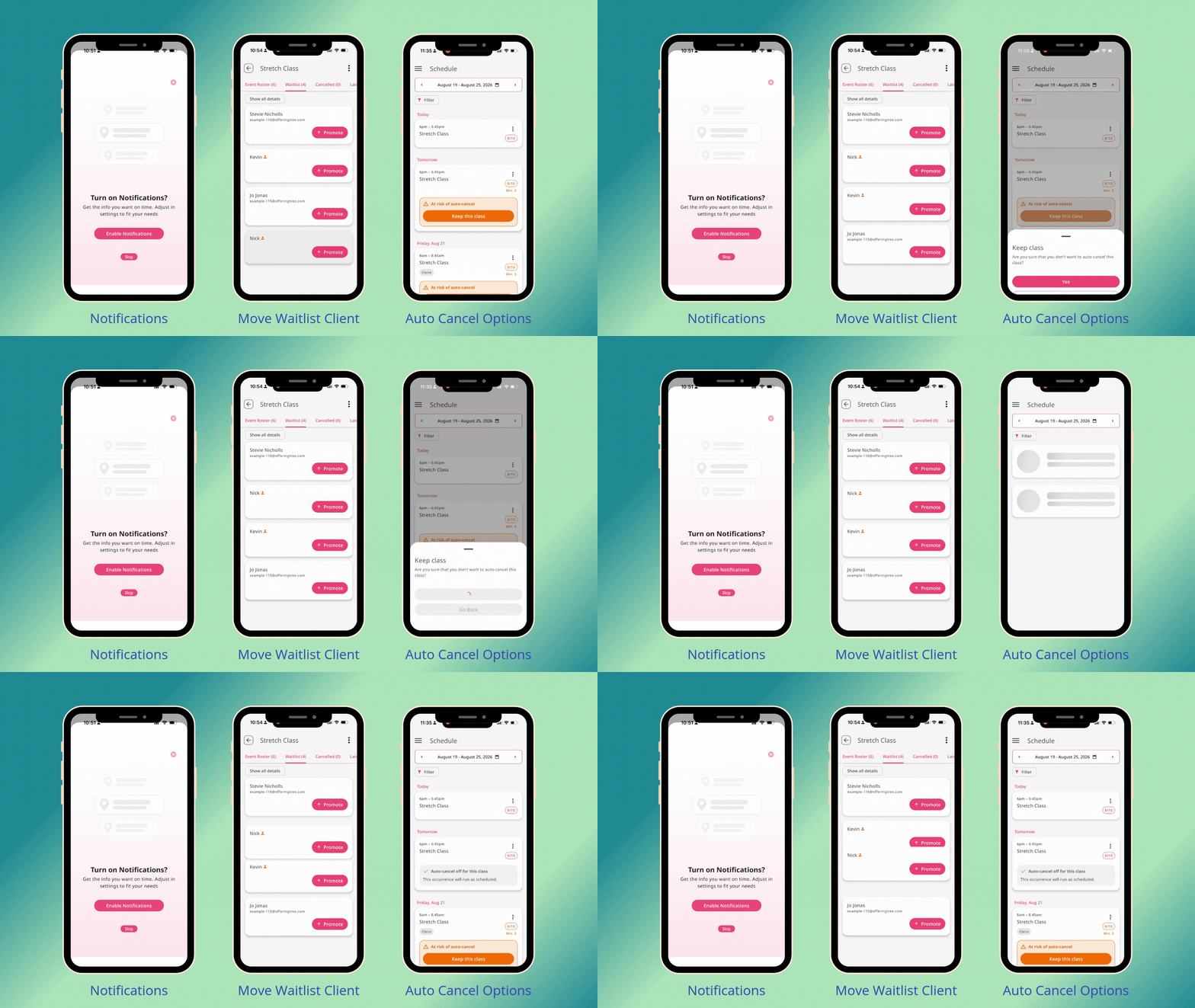
    🔔 You can now opt into push notifications, manage client texts from a full in-app inbox, override a pending auto-cancel, and drag your waitlist into the order you want.

    A few details worth knowing:

    Push notifications are opt-in, off by default. Notifications cover class registrations, appointment bookings, and cancellations of both. Staff get notified only for events they're assigned to; solo businesses get notifications for everything. You'll need to accept the OS-level prompt to activate them.

    The full Text Messaging Inbox is now in the app. Requires the Conversational Text Messaging add-on. Incoming messages notify anyone with the "Read and Respond to Client Messages" permission.

    Minimum enrollment auto-cancels can be overridden from your phone. Only appears for classes with a minimum enrollment threshold set. No notification goes to registrants.

    Waitlist reordering works with a press and hold. Drag people into priority order — whoever's first gets the next open spot.

    Available on all plans, with individual capabilities gated as follows:

    • Push notifications: all plans
    • Text Messaging Inbox: Conversational Text Messaging add-on required
    • Minimum Enrollment override: Pro Plus, Studio Starter, Studio Grow, Studio Max
    • Waitlist reordering: Pro, Pro Plus, Studio Starter, Studio Grow, Studio Max

    Comments

  3. Fixed-Date Payment Plans for Events

    Improvement

    image

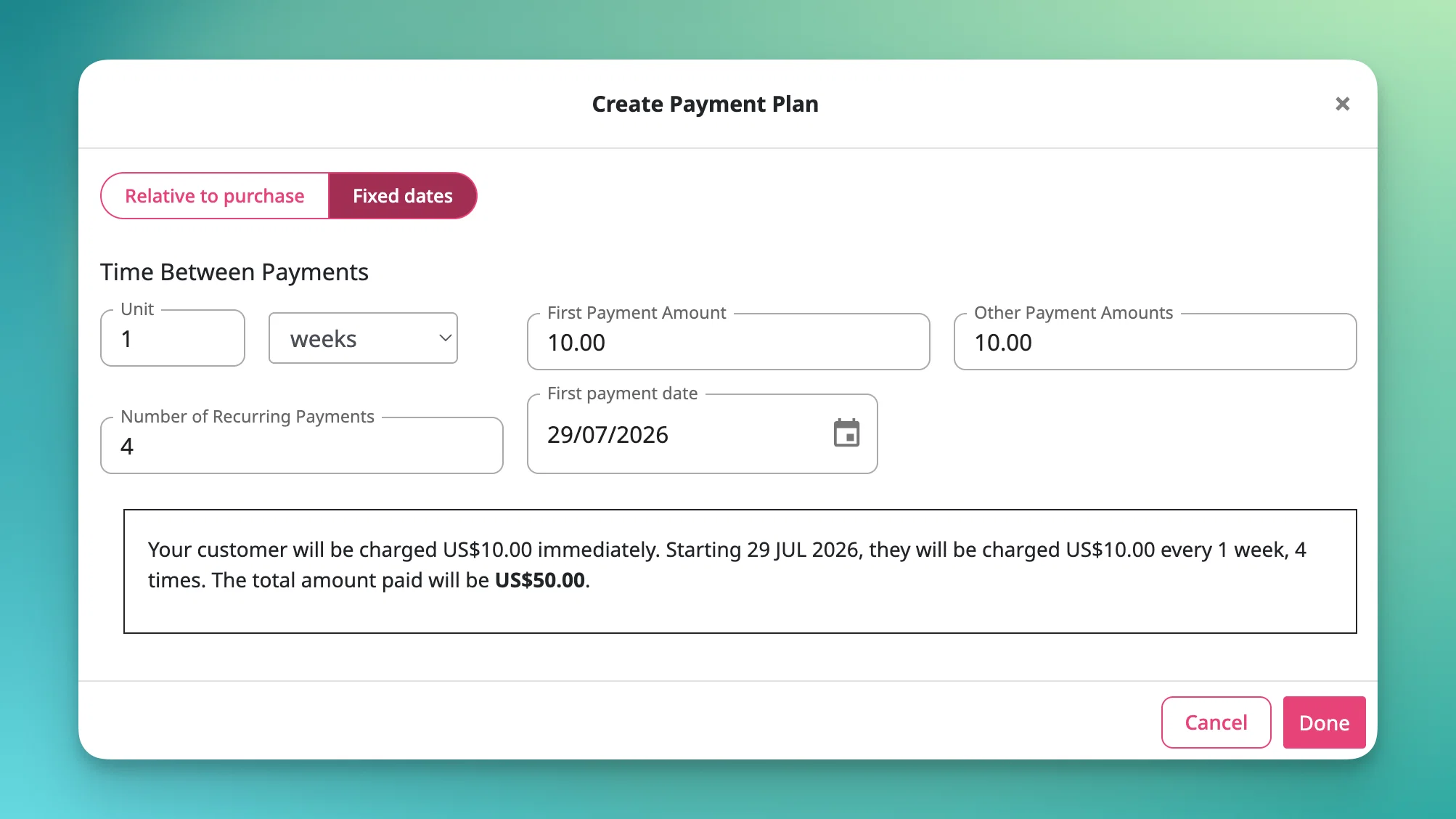
    Payment plans have always started counting from the registration date, so clients who sign up weeks apart end up on completely different schedules. That's a problem for retreats and other events where you need everyone paying on the same timeline.

    Now you can set a fixed calendar date for a plan's first payment. 📅 The rest follow their normal interval from there, so everyone on the offering lands on the same schedule no matter when they registered. You can also edit the date or amount of any upcoming payment after someone's already registered.

    A few details worth knowing:

    • If a client registers after the fixed date has passed, their first payment is charged that day, then the schedule continues as normal.
    • Already-collected payments can't be edited, only upcoming ones.

    Available on Pro and above.

    [Read the help article]

    Comments

  4. Custom Waiver Terms & Scroll-to-Agree

    Improvement
    Waiver Update

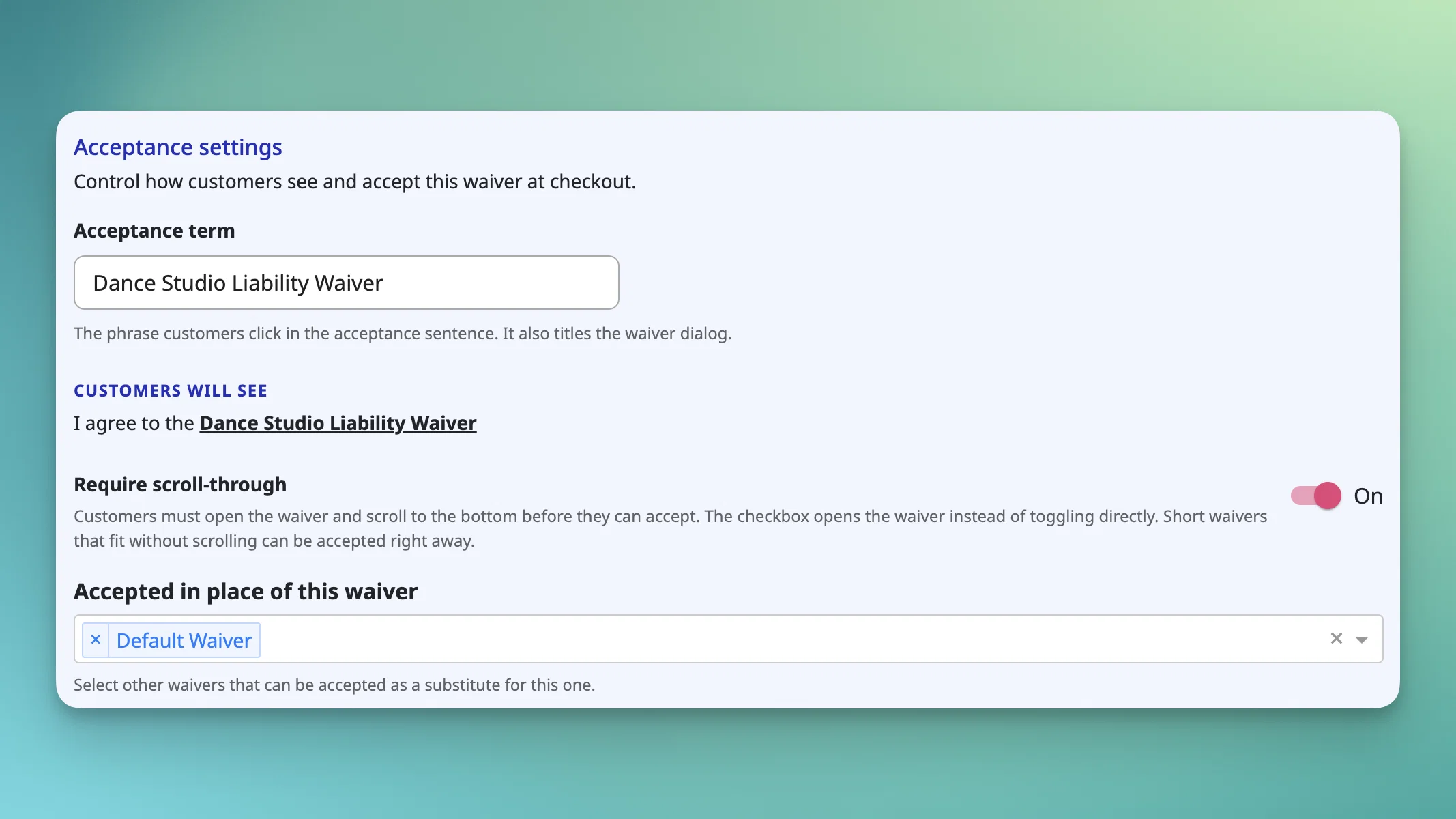
    📝 "Terms & Conditions" never quite fit. Whether it's a liability waiver, studio policy, or membership agreement, businesses can now relabel that checkbox to match the actual document clients are signing.

    Each waiver can also require clients to open it and scroll to the bottom before the agreement checkbox unlocks, so a signature actually means someone read the thing.

    A few details to know:

    • Both settings live on the Waivers page, set per waiver, so a business can label and enforce each one differently.
    • The custom term replaces "Terms & Conditions" everywhere the agreement appears during registration or checkout.
    • No custom term? No change. Waivers without one keep showing "Terms & Conditions," and existing waivers stay as-is until edited.
    • With scroll-to-agree on, the checkbox stays locked until the client reaches the end of the waiver modal.
    • Scroll-to-agree is off by default, so nothing changes for businesses that don't turn it on.

    Available on all plans.

    Comments

  5. Automatic Cancellation for Under-Enrolled Classes

    New Feature
    image

    Running a class that only draws one or two people rarely makes sense. But catching a low-enrollment class in time, deciding to cancel it, and messaging everyone affected is a manual scramble businesses often don't catch until it's too late.

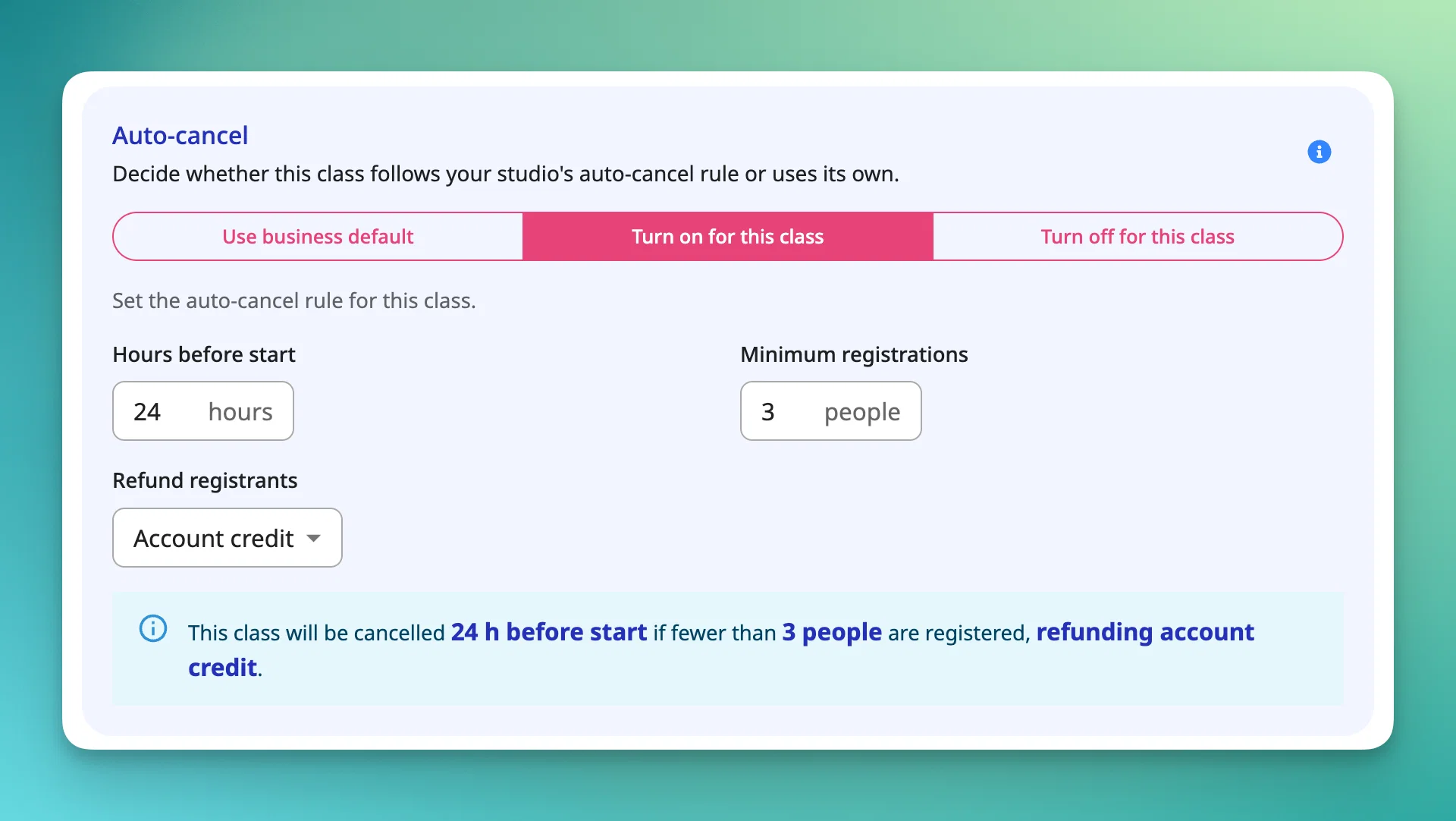
    Now you can set OT to handle it for you. Choose a minimum enrollment count and a cutoff window for any class (for example, cancel automatically if fewer than 4 clients are registered 12 hours before start). If the class doesn't hit that minimum by the cutoff, OT cancels it and notifies everyone involved. 🗓️ You'll get a heads-up before it happens, so you can step in and keep the class on the books if you want to.

    A few details worth knowing:

    • You set the minimum enrollment count and cutoff window (hours before class start) individually for each class.
    • Before auto-cancel kicks in, the assigned staff member and business owner get an advance alert with the option to override and hold the class.
    • Overrides only work before the cutoff. Once the cutoff passes and the class is auto-cancelled, it can't be reinstated.
    • If nobody overrides it, the class cancels at the cutoff and notifications go out to the business owner, assigned staff, and all registered clients.
    • You choose how refunds are handled, either back to the client's card or as account credit.
    • Enrollment is checked once, right at the cutoff. Any changes after that point won't reverse the decision.

    Available on Pro Plus and above.

    [Read the help article or watch the video]

    Comments

  6. Registration Cutoff Defaults

    New Feature

    image

    Setting the same registration cutoff on every event gets old fast, especially when your policy never changes. Previously, that meant re-entering the same rule each time, and any event you missed quietly fell back to the platform default.

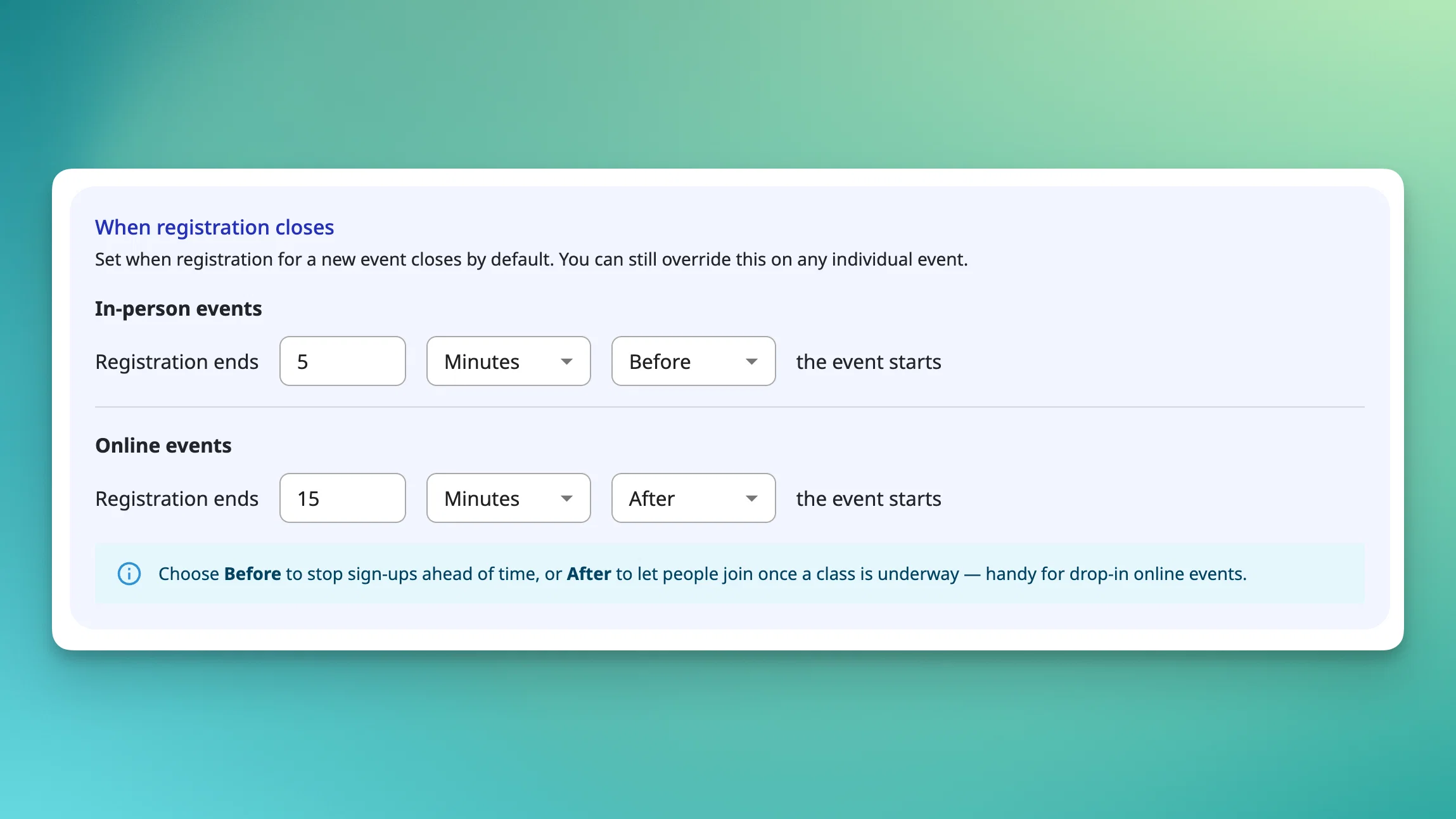
    🕐 You can now set a default registration close time for your whole account under Settings → Registration Settings, with separate defaults for in-person and online events. New events inherit the right default automatically, and you can still override the cutoff on any individual event when it needs different treatment.

    A few details worth knowing:

    • Where to find it: Settings → Registration Settings → "When registration closes."
    • Two independent defaults: one for in-person, one for online, since the right policy usually differs.
    • Before or after: set each default as time before or after the event starts. Before stops sign-ups ahead of time; After lets clients join after a class is underway, useful for drop-in online events.
    • Zero means open: a default of 0 hours before keeps registration open until the event begins.
    • Overrides still work: this adds a default, it doesn't replace event-level control.

    Available on all plans.

    [Read the help article or watch the video]

    Comments

  7. AI-Readable Site Profiles

    Improvement

    More clients are turning to AI assistants like ChatGPT, Claude, and Perplexity to find and vet wellness businesses. The problem is those tools have to guess at what a business offers by crawling a webpage built for human readers, so classes, packages, and services often get missed or described inaccurately.

    Every OfferingTree website now automatically publishes an llms.txt file 🤖, a clean, standardized index of your site's offerings that AI assistants can read directly. It refreshes daily alongside your sitemap, so it stays current as you add or update content. There's nothing to set up.

    A few details worth knowing:

    • Published automatically. Every site gets one at yoursite.com/llms.txt, with no toggle or opt-in required.
    • What it includes. Offerings, packages, blog posts, store items, and site pages.
    • Always current. Rebuilt daily on the same cycle as your sitemap, so new or edited content shows up on its own.
    • The payoff. AI assistants can discover, describe, and recommend your business more accurately.

    Available on all plans

    4

    Comments

  8. Video Captions & Transcripts

    New Feature
    Captions & Transcripts

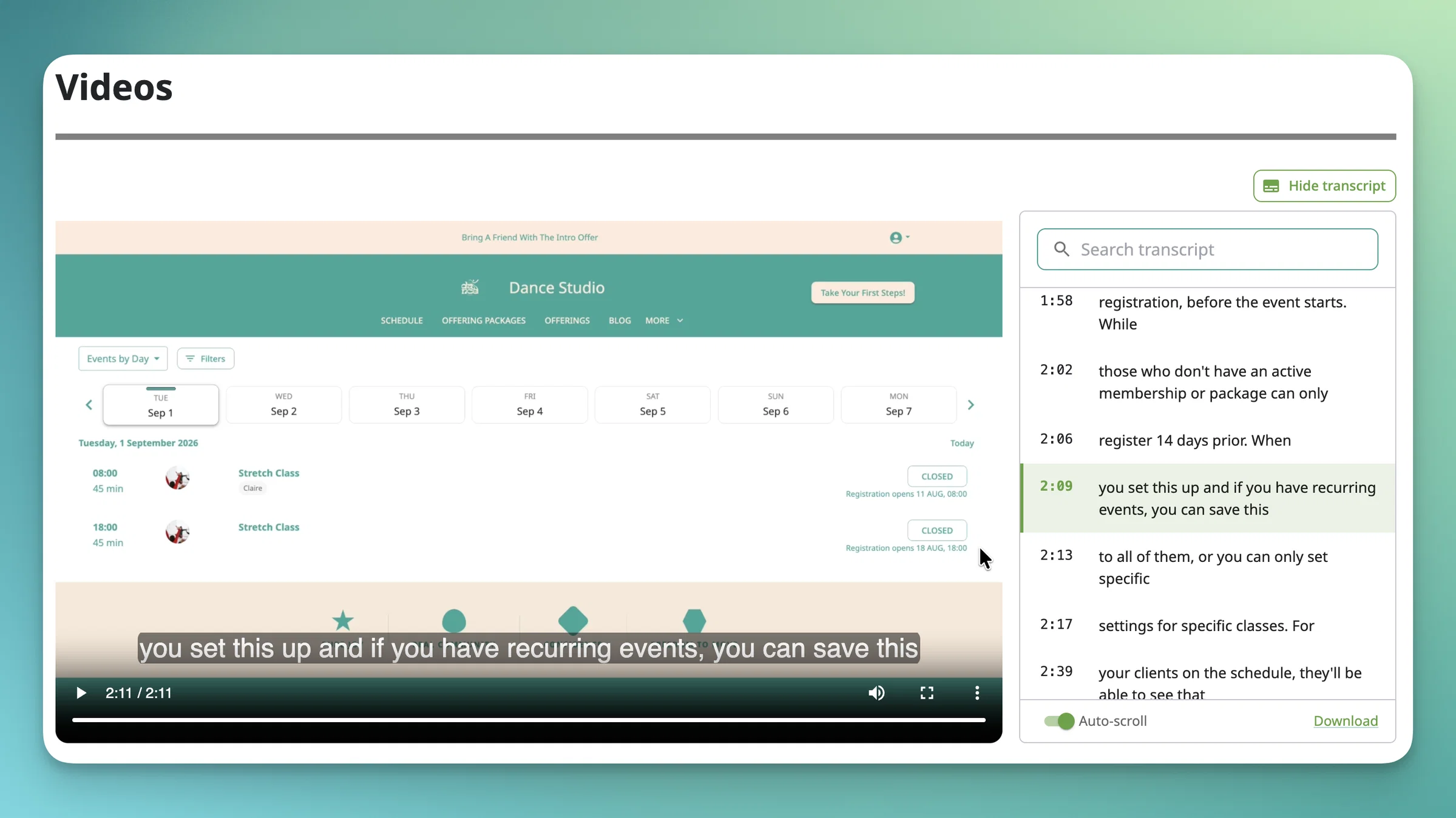
    Studios sharing on-demand classes and courses haven't had a built-in way to add captions, which made content harder to follow for deaf and hard-of-hearing clients, non-native English speakers, and anyone watching with the sound off.

    Now you can upload a caption file (.vtt) to any video in your store or courses. Clients get a CC toggle right on the player, plus something extra: a scrolling, clickable transcript panel that highlights each line as it plays and lets viewers jump to any point just by clicking the text. 📝

    Because captions and the transcript come from the same uploaded file, there's only one file to manage, but two ways for clients to engage with it. Viewers can turn each on or off independently, so someone following along with a yoga flow can keep the full video visible, while someone who'd rather read can rely on the transcript alone.

    A few details worth knowing:

    • Uploading a caption file is free on every plan. .vtt is the standard caption format, and it's what Zoom exports to.
    • The transcript panel is searchable, so viewers can find a specific phrase and jump straight to that moment in the video.
    • Viewers can download the transcript as a standalone file.
    • AI-generated captions (using Sprout credits, powered by AssemblyAI) are coming in a future release, along with an editor for fixing up auto-generated text, especially handy for Sanskrit terms and pose names. For now, businesses supply their own .vtt file.

    Available on all plans: Essentials, Pro, Pro Plus, Studio Starter, Studio Grow, and Studio Max.

    [Read the help article or watch the video]

    2

    Comments

  9. OfferingTree Business Mobile App

    New Feature
    Business App(1)

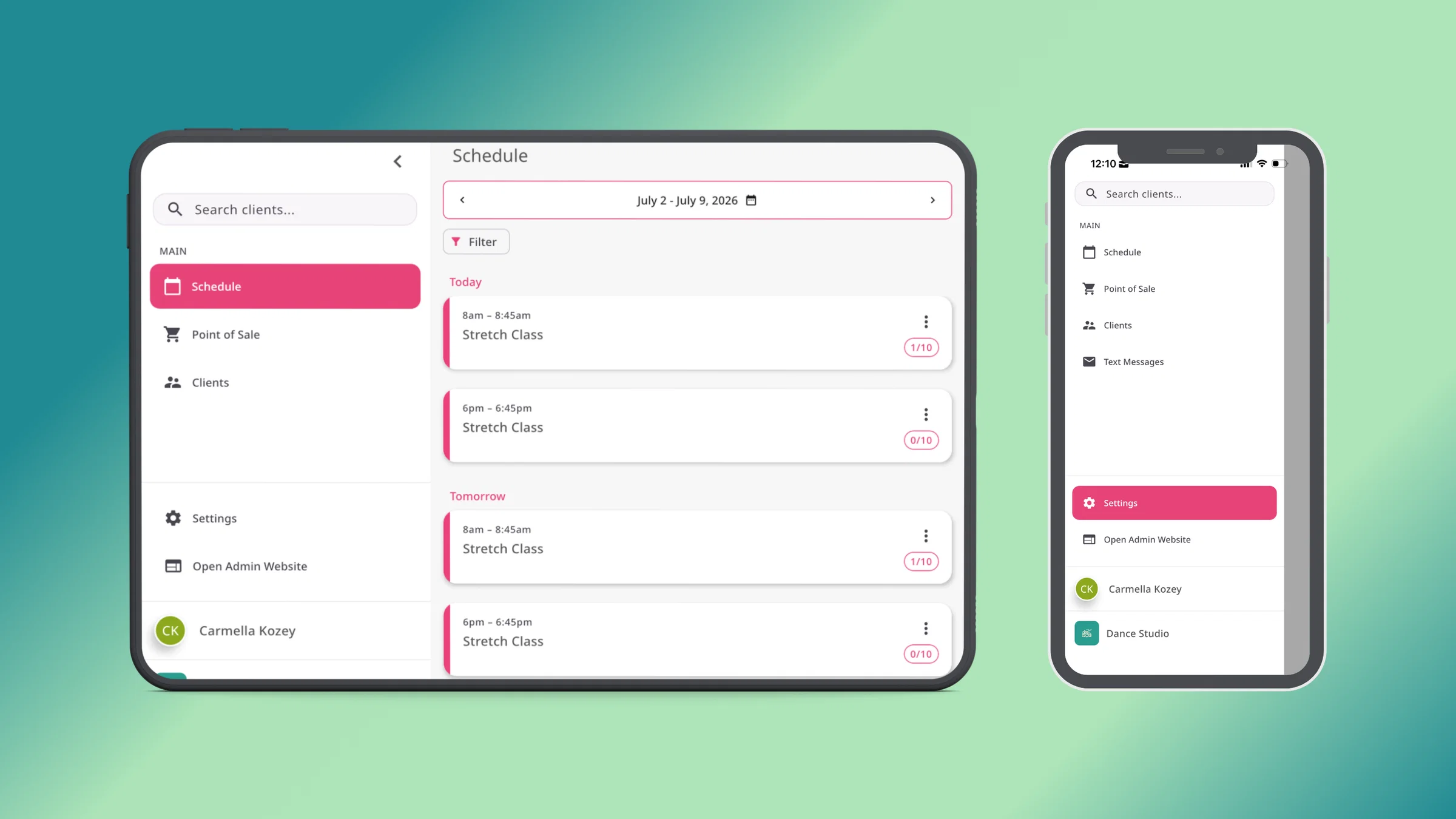
    📱 Running the front desk from a laptop has always worked, but it was never really built for the pace of a busy studio. The new OfferingTree Business mobile app changes that.

    Available on iOS and Android, the app is a dedicated experience for studios to manage front desk operations from a phone or tablet. Staff can handle the most common pre-and-post-class workflows in a touch-friendly interface designed for quick interactions, not deep administration.

    Here's what you can do at launch:

    View class rosters and tap into any session to see the full registration list.

    Check clients in with a single tap, with membership status, notes, and visit history accessible inline.

    Process sales through the full point-of-sale, including memberships, packages, and other offerings, with the same functionality available on the web app.

    Take payments through the existing WiFi-connected Stripe terminal.

    A few things on the roadmap but not in this release:

    Tap to pay directly on supported devices and text messaging or push notification capabilities are all planned for future updates.

    Available on all plans.

    See it now on the app store:

    Apple App Store

    Google Play Store

    [Read the help article or watch the video]

    2

    Comments

  10. Reusable Message Templates

    New Feature
    Select Template for Email


    ✉️ Personalizing client notifications used to mean editing every event one at a time, or living with OT's hard-coded defaults. Not anymore.

    Build a per-account library of email and SMS templates that can be pulled into newsletters, automations, or per-event notifications. Pick one from the picker and it pre-fills the editor, ready to tweak before saving.

    Every account also gets 8 default notification templates seeded with OT's standard copy, covering event and appointment registration confirmations and reminders across email and SMS. Edit them once and they apply everywhere a custom override isn't set.

    A few things to know:

    • Three template types are supported: visual email, rich-text email, and plain-text SMS. The picker only shows what fits the editor you're in.
    • Templates are a starting point, not a live link. Editing one later won't change messages that already went out.
    • Defaults can be edited and restored, but not deleted.
    • SMS template editing requires the SMS customization feature. Default SMS templates still send for all accounts regardless.
    • Attachments are dropped when a template is used in an automation node. The UI will warn you before that happens.

    Available on all plans.

    [Read the help article or watch the video]

    Comments